

PlaceEngage_The-People-&-Places-Engage-Framework .pdf
As Ireland moves beyond its centenary as an independent nation, the importance of effective public participation in shaping our communities has never been more apparent. Henry (2021, p.387) writes that “greater trust helps build better communities, which helps improve its economic wealth, which helps build greater trust, which helps build better communities”. This cyclical relationship between trust, community engagement, and prosperity serves to highlight the critical role that public participation plays in community life, including through planning and development. The recent COVID-19 crisis further demonstrated the value of collaboration between local authorities and Public Participation Networks (PPNs) in engaging and assisting the public (Hogan, 2022, p.213). This unexpected challenge has accelerated the adoption of digital engagement tools across many sectors, while also highlighting the persistent need for inclusive, accessible participation methods. At the heart of effective public engagement lies the concept of empowerment (Arnstein, 1969Chinchilla (2022, p.21) defines this as “giving citizens resources and authority, opportunity and motivation, while making them co-participants in the results of their actions, contributing to their competence and satisfaction”. This empowerment is not a one-way process, but rather a “two-way process, (facilitated by professionals/planners) involving interaction and listening, with the goal of generating mutual benefit” (Chinchilla, 2022, p.21). However, the path to meaningful public participation is not without challenges. Historically, there has been a tendency to view planning as the domain of experts, with citizens told from childhood that “the planning, design and building of any part of the environment is so difficult and special that only the gifted few… can properly solve environmental problems” (Nicholson, 1972, cited in Chinchilla, 2022, p.107). This technocratic approach has often led to the marginalisation of public voices and local knowledge (Innes and Boher 2008). Significantly, there is a concerning trend of avoiding conflict in public engagement processes, which Chinchilla (2022, p.107) argues “not only perpetuates the interests of one group over the diversity of citizens; it is that, in addition, we avoid working on mechanisms for social dialogue that can only become effective with practice and with repeated cultivation of trust-building processes”. This avoidance of conflict can lead to a false perception that participation processes are ineffective, when in reality; they may just require more development and refinement combined with the correct upskilling and training of those facilitating the processes. In response to these challenges, this chapter, drawing from the findings in Chapter 4, proposes a new framework for facilitating and enhancing both statutory and non-statutory public consultation and community engagement in Irish local authority planning. Termed by the author as: The People & Places Engage Framework, this framework is rooted in the belief that diversity, far from being a source of conflict, “can be a source of harmony” and that “uniformity can destroy rather than advance civilization” (Augsburger, 1992, p.7).
The People & Places Engage Framework (PPEF) aims to harness the potential of digital technologies while addressing issues of accessibility and inclusivity. It emphasises the importance of capacity building, not just for planners but for citizens as well. As Hoffman et al. (2005) suggest, effective citizen engagement involves both empowering citizens with skills to evaluate and act on issues, and allowing researchers to gather valuable real-world data. This dual benefit demonstrates the importance of building capacity among all stakeholders in the planning process. Ultimately, The PPEF is rooted in the principles of the Aarhus Convention, which emphasises access to information, public participation in decision-making, and access to justice in environmental matters (Hua et al., 2023), and incorporates the values of the New European Bauhaus initiative, which calls for sustainable, inclusive, and aesthetically pleasing solutions to urban challenges (Hua et al., 2023). The Framework leans into the concept of the collective drafting of a ‘Declaration of Rights of the inhabitants of the City’ as suggested by Chinchilla (2022, p.163-164), including “the right to understand and contribute to the construction of the empirical evidence that should be used to design the city” (Chinchilla, 2022, p.165). By doing so, the aim is to create a more participatory, inclusive, and responsive approach to spatial planning in Ireland, one that truly reflects the needs and aspirations of all citizens as the nation moves into our second century of independence.
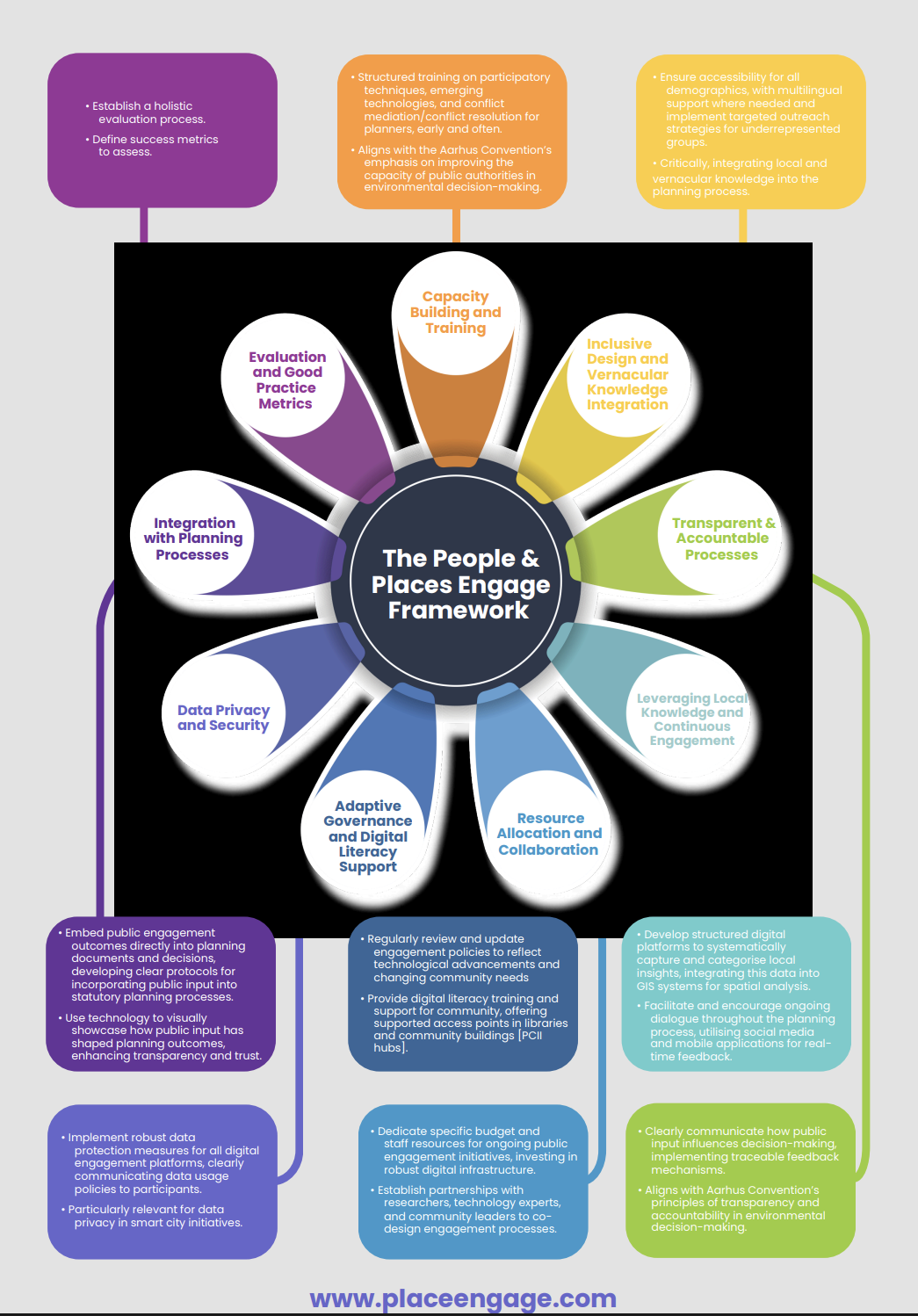
Proposed ‘People & Places Engage Framework’
The People & Places Engage Framework (PPEF) is a novel approach designed to enhance public participation in spatial planning, aided by digital means. The framework draws upon the insights from the academic literature and the shared experiences of Ireland’s public sector planners, addressing the identified challenges and opportunities in digital engagement. It aims to balance the potential of digital technologies with the need for meaningful, equitable participation in spatial planning. The PPEF proposes a Hybrid Engagement Approach, which could Implement a combined strategy of digital and traditional methods to cater to diverse preferences and ensure inclusivity. This approach should utilise user-friendly online platforms complemented by in-person consultations, addressing the digital divide concerns raised by Pantic et al. (2021). Incorporate virtual rooms, 3D modelling, and interactive maps for better visualisation, as suggested by Toukola et al. (2022) and several of those interviewees for this dissertation, while maintaining face-to-face options to ensure accessibility for all demographics.
- Capacity Building and Training: Respondents reflected on the need for CPD, training and other opportunities for professional planners to hone their skills in participatory approaches.Therefore, the suggested approach would provide structured training on public consultation, community engagement techniques, emerging technologies, and conflict mediation/conflict resolution for planners, early and often. This would address the gap in professional development referred to by interviewees and identified by Friel et al. (2023), and aligns with the Aarhus Convention’s emphasis on improving the capacity of public authorities in environmental decision-making.
Such training would cover both traditional and digital methods, emphasising the importance of a hybrid approach to ensure inclusivity; digital literacy and emerging technologies to ensure planners are proficient in using and explaining digital engagement tools to the public. This may also create a cultural competence to ensure planners engage effectively with diverse communities and respect local knowledge and traditions. The approach would furthermore engage with conflict mediation/resolution to equip planners with skills to navigate and mitigate potential conflicts in the planning process. Chinchilla (2022) highlights the importance of not avoiding conflict:
“The problem with the fact that projects requiring collaborative governance are almost systematically short-circuited in order to avoid conflict is not only that it perpetuates the interests of one group over the diversity of citizens; it is that, in addition, we avoid working on mechanisms for social dialogue that can only become effective with practice and with repeated cultivation of trust-building processes” (Chinchilla, 2022, p. 107).
Appropriate training would enable planners to recognise potential sources of conflict early in the planning process and equip practitioners with techniques for facilitating constructive dialogue among diverse stakeholders. Such training would empower planners with trust building strategies for fostering collaboration, even in the face of disagreement, including models for reframing community conflicts as opportunities for creative problem-solving. Chinchilla further notes that “The development of creative skills and the capacity for cooperation can be taught almost uniformly to all members of the community” (Chinchilla, 2022, p. 108). This suggests that training ought not be limited to planners alone, but could be extended to community leaders and engaged citizens, enabling a shared understanding of collaborative planning processes.
- Inclusive Design and Vernacular Knowledge Integration: Research findings illustrated an awareness by interviews as to the need of engaging multiple publics in the planning process in an intergenerational way. Therefore, this approach would ensure accessibility for all demographics, including older people and those with limited digital access. Also, provide accessibility and multilingual support where needed and implement targeted outreach strategies for underrepresented groups. Critically, integrating local and vernacular knowledge into the planning process, as discussed by Hua et al. (2023), to create more sustainable, sensitive and context-appropriate solutions.
- Transparent and Accountable Processes: Clearly communicate how public input influences decision-making, implementing traceable feedback mechanisms. This aligns with the Aarhus Convention’s principles of transparency and accountability in environmental decision-making. Regularly evaluate and report on the effectiveness of engagement methods, as suggested by McCall and Dunn (2012).
- Leveraging Local Knowledge and Continuous Engagement: Develop structured digital platforms to systematically capture and categorise local insights, integrating this data into GIS systems for spatial analysis. Facilitate and encourage ongoing dialogue throughout the planning process, utilising social media and mobile applications for real-time feedback, as recommended by Wilson et al. (2019).
- Resource Allocation and Collaboration: Dedicate specific budget and staff resources for ongoing public engagement initiatives, investing in robust digital infrastructure. Establish partnerships with researchers, technology experts, and community leaders to co-design engagement processes, as suggested by Strohmayer et al. (2022).
- Adaptive Governance and Digital Literacy Support: Regularly review and update engagement policies to reflect technological advancements and changing community needs. Provide digital literacy training and support for community members, offering supported access points in libraries and community buildings for those without personal digital access.
- Data Privacy and Security: Implement robust data protection measures for all digital engagement platforms, clearly communicating data usage policies to participants. This addresses concerns raised by Gohari et al. (2020) regarding data privacy in smart city initiatives.
- Integration with Planning Processes: Embed public engagement outcomes directly into planning documents and decisions, developing clear protocols for incorporating public input into statutory planning processes. Use technology to visually showcase how public input has shaped planning outcomes, enhancing transparency and trust.
- Evaluation and Good Practice Metrics: Through multidisciplinary and community dialogue, establish a holistic evaluation process with predefined success metrics to assess and understand the effectiveness of public consultation and community engagement throughout the planning process. This approach aligns with the need for evidence-based policymaking highlighted by Reckien et al. (2021) and would address the gap in systematic evaluation noted by Ramirez et al. (2023).
Such an approach would seek to define, pre-consultation, a clear and measurable set of objectives for the consultation process, which would require the establishment of a baseline data on current levels of engagement and community satisfaction. Specific targets ought to be set for participation rates, diversity of participants, and impact on final decisions. This approach would require data collection on participation levels and demographics, regular assessment of the quality and relevance of public input received, and ongoing monitoring of the integration of public feedback into planning decisions. Post-consultation evaluation activities would include analysing participation data against pre-set targets, assessing the impact of public input on final planning outcomes, and evaluation of satisfaction.
I genuinely believe this framework provides a timely and appropriately-tailored approach to ensuring that the voices of communities are not just heard, but actively shape the future of their built environment. The successful implementation of this framework could mark a turning point in Irish planning practice, moving from consultation as a statutory obligation to engagement as a powerful tool for creating more responsive, sustainable, and community-driven spatial planning.
Project support available through Place Engage: https://placeengage.com/
*Further context on the research and data underpinning this ‘People & Places Engage’ framework can be found at: https://caroltallon.com/reimagining-citizen-participation-what-irish-planners-need-to-know-about-digital-engagement-in-2025/