
🇪🇺 Place Engage: 26 counties, 26 weeks, one shared conversation about place
iProperty Radio presents Place Engage – a non-political placemaking tour across 26 counties in the 26 weeks of Ireland’s EU Council Presidency.
Here is what we are doing, why we are doing it, and how you can take part.
From 1 July to the end of December 2026, while Ireland holds the Presidency of the Council of the EU, we are travelling to every county in the Republic – one county a week, for 26 weeks. In each county we will collate as much placemaking data as possible, before speaking to people on the ground to understand their lived experience of the place.
Inspired by decades of communicating across Ireland’s built environment – property, construction and planning – we believe that a genuinely informed public is an engaged public. And an engaged public makes for robust and resilient communities, rich in social capital, and willing to work together to shape the places where they live, work, socialise, and spend time.
Informed participation in planning and placemaking makes for better places.
When people engage and contribute to shape the places around them – if they feel listened to – they are more likely to feel a sense of belonging, and a shared sense of responsibility for the natural and built environment around them.
We intend to spend the next 26 weeks listening…
The slogan of Ireland’s EU Council Presidency is Ní neart go cur le chéile – strength in unity, which is perfect for contextualising Ireland’s place at the edge, but in the heart of the European Union.
Ours is Faigheann cos ar siúl rud nach bhfaigheann cos ina cónaí – a walking foot finds something that a resting foot wouldn’t. 😉

Why
- Because participation is the lifeblood of a democracy, and participation works best when it is informed.
- Because we believe in the EU and that the EU has a role to play in helping Ireland to tackle this persistent housing crisis/housing emergency.
- Because between statutory consultations, there are few mechanisms for people to describe their place in their own words and have that heard. We are building one, county by county.
- Because rural Ireland deserves to be understood as it is now. Roughly 36% of us live rurally; around 4% work in agriculture. Rural Ireland is a living question, not only a farming one – and post-Covid rural life is still being written.
- Because it is worth asking communities directly whether they feel heard in the planning process, and recording the answers faithfully.
- Because the New European Bauhaus puts people at the heart of local placemaking – its principles of beauty, sustainability, and inclusion are meant to be experienced where people live, and every corner of Ireland has a story shaped by EU support: a greenway, a revitalised town centre, a local initiative that changed somewhere for the better. We will look for them on the ground.
- Because climate action is decided in plans and delivered in places. What does democratic climate action look like where people live?
- Because the European principle of subsidiarity is too often read as decision-making at national level. More accurately, it means making decisions at the level closest to the communities and places affected – most appropriately, the local authority, and even the municipal district. This Irish EU Council Presidency is the right time to make sure that principle is felt and understood.
*To get involved, email carol@placeengage.com
The data
In advance of each weekly county visit, we are collating all known/available placemaking data into one single research database, including:
- Demographics – CSO: population (Census 2022) · population change 2016–22 · % urban · % rural
- Employment – CSO: persons at work · unemployment rate (Census measure) · notes on the local economy
- Planning and development – via the Property District Development Heat Map: planning permissions granted (permissions and dwelling units) · one-off house permissions (count and share of units) · planning applications received and decisions by local authority · housing supply pipeline (permitted / activated / inactive) · residentially zoned land under RZLT (hectares) · housing growth requirement versus actual delivery · new dwelling completions · commencements · notable new development and schemes
- Sales market – using primarily CSO, RPPR, Daft.ie and MyHome.ie: homes listed for sale (with date checked) · median sale price · price reference period and source
- Rental market – using primarily CSO, RPPR, Daft.ie and MyHome.ie: homes listed to rent (with date checked) · standardised average rent (RTB) · registered private tenancies (RTB) · Notices of Termination received (RTB)
- Affordability and scheme take-up – Gov.ie: median gross household income · price-to-income ratio (derived, both inputs stated) · First Home Scheme approvals and drawdowns
- Vacancy and stock condition – Various sources: residential vacancy rate · Vacant Property Refurbishment Grant applications and approvals · commercial vacancy rate (GeoDirectory) · domestic BER, share rated A or B
- Economic development – CSO and local Chamber publications: largest employment sectors · disposable income per person · FDI employment (reported regionally, and stated as such)
- Housing need – Gov.ie: households in emergency accommodation · duration of stay · exits and preventions · Housing First tenancies
- Low-carbon transition – Various sources: grant-supported home energy upgrades · EV share of new private cars · Sustainable Energy Communities · each local authority’s statutory Climate Action Plan 2024–2029 and its decarbonising zone
- Transport and mobility – Various sources and reports: commute mode share · average commute time · active travel allocations by local authority · major transport projects and status
- Placemaking – Various sources: Town Centre First towns · New European Bauhaus initiatives · local authority public realm programmes · community voices themes, gathered by us in person
*If you see any issues with our data, or gaps in our areas of focus, we welcome feedback!
What the first county has already taught us
Assembling Dublin’s row this week produced observations we did not expect, and this is where the database becomes more than a spreadsheet:
- The same fact can carry two honest measures. Dublin’s planning activity counts 1,877 permissions in the first quarter of 2026 – but two-thirds of them are extensions and alterations, not new construction. The capital’s planning system spends most of its time adapting the city we already have. That is a placemaking finding, not just a statistic.
- Targets have moved. The July 2025 Section 28 guidelines raised Dublin’s required delivery to 18,204 homes a year to 2034 – up from 10,418 under the 2020 methodology. Dublin delivered roughly three-quarters of the new annual requirement in 2025. Both halves of that sentence deserve to be said together: delivery is rising, and the bar has risen faster.
And some questions have become harder to answer. Ireland’s planning open data has expanded remarkably – live registers, pipeline monitors, a national delivery tracker. Along the way, one older convenience lapsed: the routine annual summary of applications, decisions and refusal rates by local authority. Deriving today’s refusal rates from the National Planning Application Database is now on our work plan, and we will publish the method with the numbers.
The ground game: a cultural mapping
Data describes a place. It does not describe what it feels like to live there. So in every county, our time on the ground is spent with people.
In addition to interviews on the ground, an online survey, and digital emoji sentiment gathering, our on-the-ground engagement method is deliberately simple. Three overarching questions, answered by hand on a post-it note:
- What works well where you live?
- What’s not so great?
- What would you love to see for your area?
In Dublin, week one, among the first answers written down were “Luas” and “traffic” – a transport story told in two words, before we had opened a single dataset. When the handwritten notes and the official figures agree, we have confirmation. When they differ, we have a question worth asking – and that gap between the record and the lived experience is precisely what this series is for.
Alongside the notes: conversations with the people who know their county’s ground truth – including, in every county, a local Institute of Professional Auctioneers and Valuers (IPAV) auctioneer or estate agent on real market conditions, trends emerging (for example, cash buyers in their 30s, and the start of price reductions for less “polished” homes in Dublin South).
Our only agenda is to listen, and to gain a better/truer understanding of how people feel about their place, and their role in shaping that place.
We’d love you to get involved: www.placeengage.com
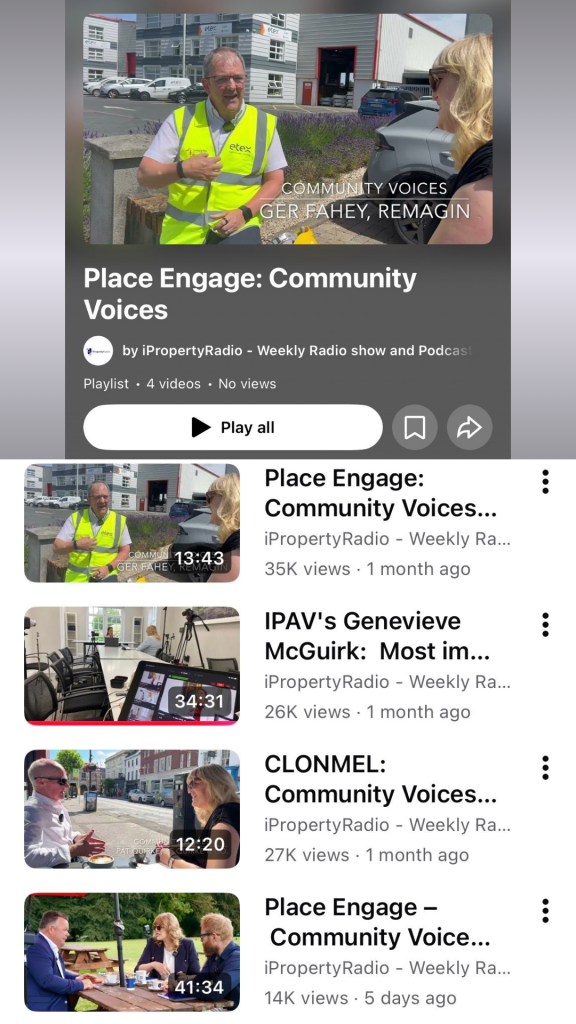
*Follow our more in-depth ‘Community Voices’ interviews as we travel around the country: https://youtube.com/playlist?list=PLbsPGDsfbG3U&si=iPhW6oHPF7OQHyVq
- Week 1: Dublin – Where the Numbers Meet the People: https://placeengage.com/week-1-dublin-where-the-numbers-meet-the-people/
- Week 2: Tipperary – https://placeengage.com/week-2-tipperary-placemaking-in-every-town/
- Week 3: Donegal – https://placeengage.com/week-3-donegal-a-tale-of-two-property-markets-and-the-places-between-them/
- Week 4: Wexford – https://placeengage.com/week-4-wexford-one-county-several-markets-happy-residents-in-a-heatwave/
- Week 5: Louth –https://placeengage.com/the-smallest-county-building-above-its-size-a-louth-placemaking-baseline/
- Week 6: Kilkenny – https://placeengage.com/county-kilkenny-a-small-city-carrying-a-national-spotlight/
- Week 7: Carlow – https://placeengage.com/%f0%9f%87%aa%f0%9f%87%ba-week-7-of-26-place-engage-arrives-in-county-carlow-the-second-smallest-county-in-ireland-and-one-of-the-fastest-changing/
- Week 8: Meath – https://placeengage.com/🇪🇺-week-8-of-26-placemaking-in-county-meath/
- Week 9: Westmeath – https://placeengage.com/%f0%9f%87%aa%f0%9f%87%ba-week-9-of-26-placemaking-in-county-westmeath/
- Week 10: Cork – https://placeengage.com/irelands-most-rooted-county-people-rarely-leave-and-when-they-do-they-return/
- Week 11: Kerry – https://placeengage.com/%f0%9f%87%aa%f0%9f%87%ba-week-11-of-26-place-engage-arrives-in-county-kerry/
- Week 12: Offaly – https://placeengage.com/%f0%9f%87%aa%f0%9f%87%ba-week-12-of-26-placemaking-in-county-offaly/
- Week 13: Waterford – https://placeengage.com/%f0%9f%87%aa%f0%9f%87%ba-week-13-of-26-placemaking-in-county-waterford/
- Week 14: Wicklow – https://placeengage.com/%f0%9f%87%aa%f0%9f%87%ba-week-14-of-26-placemaking-in-the-garden-county-place-engage-comes-home-to-county-wicklow/
- Week 15;
- Week 16:
- Week 17:
- Week 18:
- Week 19:
- Week 20:
- Week 21:
- Week 22:
- Week 23:
- Week 24:
- Week 25:
- Week 26: