
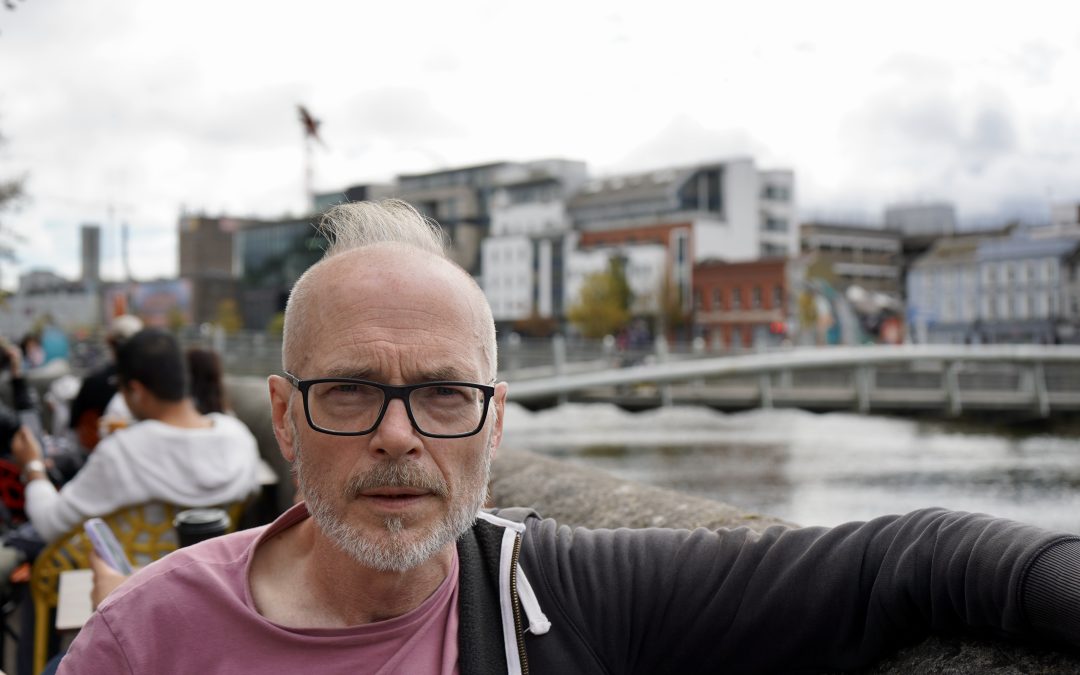
Community Voices: Carol Tallon in conversation with Frank O’Connor of #DerelictIreland
One of the richest, most wide-ranging, placemaking conversations of this 26-county, 26-week non-political placemaking tour so far.

A conversation on Pope’s Quay with the co-founder of #DerelictIreland — about a campaign built with no budget and no institution behind it, about why the walk matters more than the meeting, and about a village in north-west Cork that came back.
This is part of Place Engage, a non-political placemaking series running across all 26 counties throughout the 26 weeks of Ireland’s EU Council Presidency, brought to you through iProperty Radio. Each county week begins with a Placemaking Data Baseline built from primary sources; the rest of the week is spent on the ground, testing that record against what people actually experience. County Cork is Week 10.
*Watch in full: https://youtu.be/S8M44XTYrxY
We are sitting outside on Pope’s Quay in Cork city, in the sun, with the river in front of us and a long-term derelict site directly across the water. Frank O’Connor points at it without breaking stride. That is roughly how the whole conversation goes: the subject is never far away, because in this city you can generally see it from wherever you are sitting.
Frank and his partner Jude Sherry co-founded #DerelictIreland, and together they run anois.org, a sustainable design practice. They moved back to Ireland in 2018 after decades away — Amsterdam most recently, Cardiff before that — having worked internationally on products, resources, cities and urban systems. He is from Kiskeam in north-west County Cork, close enough to the border that, as he puts it, people locally will tell you he is really from Kerry.
“Immersion Cork”
They came back a year before they moved, quietly, and told nobody. They walked over the Shandon footbridge together for the first time, up the steps into Shandon, and decided there and then. What sold it was the friendliness of the people and the character of that part of the city — the history and heritage of the north side.
On their first day, Frank opened a new notebook and wrote Immersion Cork on the front. That is the method, and it has not changed since. They walked the city, cycled it, mapped it, photographed it and talked to people in it, for the best part of two years before they published anything.
What they could not get past was the vacancy. Coming from Amsterdam, where he says vacancy exists but is short-term, the level of empty and decaying building stock in Cork was, in his word, shocking. Five things came out of that first period of walking: vacancy, dereliction, people on the streets, the housing and homelessness crises, and decaying heritage. And underneath all five, the finding that has driven everything since — that dereliction in Ireland had become normalised. Not disputed, not defended. Simply accepted as the way things are.
A daily dose of dereliction
In June 2020 they started posting one derelict property a day on Twitter, all of them within two kilometres of Cork city centre, under the hashtag #DerelictIreland. They called it a daily dose of dereliction and expected it to run for a few weeks. It ran for a full year.
Alongside it, Jude built the data. They documented 340 derelict properties inside that two-kilometre radius and researched the planning and sales history of each one. In March 2021 they published This is Derelict Ireland, an independent, entirely self-funded report which sets out to debunk what it calls the ten deadly myths of dereliction — the reasons people give for why nothing can change. It remains, on its own description, the largest study of dereliction in Ireland.
The number that travelled furthest was the comparison: 340 properties documented within two kilometres of the city centre, against 95 on the local authority’s derelict sites register at the time. It is the same distance between what is recorded and what is actually there that this series found in Kilkenny in Week 6, where roughly 2,100 properties sit on local authority derelict registers nationally against a Government working estimate for the incoming derelict property tax running to as many as 19,000.
The Derelict Sites Act has been on the statute book since 1990. Frank’s position is that the instruments largely exist and the enforcement does not — which is, almost word for word, the conclusion this series reached in Kilkenny before ever arriving in Cork.
The walk, not the meeting
The part of this that I keep returning to is not the data. It is the method.
When people started making contact, Frank and Jude did not meet them for coffee. They took them for a walk — often starting on that same Shandon footbridge. Hundreds of people, over years. His reasoning is practical rather than romantic: you learn far more about a person’s place by walking it with them than you do across a table, and the walk builds the relationship in both directions at once.
It also surfaced something he says surprised them. A great many of the people who contacted them — people with real expertise in placemaking, in pedestrianisation, in urban design — had never actually walked the streets they were talking about.
The walks got bigger. Five years ago this month they ran what he describes as the first dereliction festival in Ireland: a three-hour walk from the north side, through the historic core, out to the port, taking in something like seventy buildings, with poetry and music along the way. Part protest, part festival. The format then travelled to Dublin, Limerick and elsewhere. Today they run paid dereliction tours — which, he is careful to say, are as much about placemaking, livability, heritage and materials as about empty buildings.
And they make unsanctioned street art on derelict buildings, in daylight, in white jackets and hard hats, on subjects including the mother and baby homes, housing and dereliction itself. He is a visual artist, and he does not pretend the work is neutral: art is political, in his account, and so is this.
The campaign self-organised outward from there, with groups forming in Dublin, Limerick, Galway, Waterford and beyond. The design principle was deliberate: no hierarchy, no central permission, no house style. Inspire people, then let them do what suits their own town or city. Some groups became formal and work closely with their local authority; others stayed flat and informal. That fluidity was the point.
Rest, play, work
The model they work to is three words: rest, play, work. Everyone should have access to a home, to a place to play and create, and to meaningful work. Rest comes first, and it is the part he speaks about with the least distance.
He describes children walking to school from emergency accommodation past a run of vacant and derelict properties — some of those children in emergency accommodation for two, three, four, five years. He does not present that as an argument. He presents it as something he sees on his own street.
The second element is community, and here he is talking about space rather than sentiment. We are, he notes, having this conversation over coffee we had to buy. What a place also needs is somewhere you can sit without spending. He reaches for Valencia — nine or ten at night, six-year-olds and eighty-year-olds out on the street together — and for Rotterdam, where he watched families walk past a play space, the child stop for a swing, and the family carry on. That, he says, is a culture we are still a long way from.
His framing for it is the one I found most useful in the whole conversation: Ireland’s default is public squalor, and the argument he and Jude make is for public luxury. As cities densify and people move into smaller homes, the case gets stronger rather than weaker — if the public realm is good enough, the private space does not have to carry everything. He adds a Cork-specific observation: much of the river is closed off, and residents are effectively discouraged from a defining part of their own city.
One more thing he raises, unprompted, that I had not expected. He credits the international community arriving in Cork with adding to the sense of place, precisely because people are coming from cultures where sitting out, using the river, using the trees is normal — and spaces in Cork that were never really used are being used now.
What it has cost
It is worth recording plainly that this has not been free for them, even though the campaign has had no budget.
He is direct about the commercial consequence: doing this work in the city where you live makes it harder to be hired in that city. They were told that at the outset and accepted it.
The pushback, on his account, has come from a spread of quarters — some local authority resistance in Cork itself, though support from local authorities elsewhere; from parts of academia; from people in property and from landlords; and from some architectural quarters. For every source of pushback, he says, there has been support from somewhere else, and people who objected four years ago are sometimes onside now.
His explanation for the academic pushback is the one I would most like to see tested, because it is uncomfortable and I do not think he is wrong: the work is non-institutional. It is not anchored to a university, an NGO or a department, and it takes no money from any of them. In his reading that is exactly what gives it independence and exactly what makes it hard for institutions to place.
I put it to him that non-institutional work is a poor reason for academic resistance and a good reason for academic collaboration. My own view, for what it is worth, is that we need what I have started calling the trust trifecta — the robustness of public sector data, the real-time relevance of industry, and the rigour of academia — working together rather than separately. On the evidence of eight years of this campaign, the grassroots layer belongs in that too.
He is also, deliberately, political but not party-political. Any party that asks to meet gets the same offer as everybody else: come for a walk. None of them gets an alignment.
Kiskeam, and the county the data says stays
Our Week 10 research found that Cork is the most rooted county in Ireland: 72% of people living here were born here, the highest of any county in the State, against a national figure of just under 60%. Cork people are also the least likely in the State to move out of their county. Two weeks ago we were in Meath, at the other end of the same national table, at 32%.
I said I found it counterintuitive for a county with a city of this scale. Frank did not. He said he sees it in Shandon and he sees it in the local pub — and then he took the conversation out of the city entirely, to Kiskeam.
Kiskeam, he says, was at one point entered into a competition and came out at the very bottom, regarded as the dirtiest village in Ireland. It has been transformed since, over generations of community effort, with younger people now taking it on. In July of this year Kiskeam Village was one of five County Cork entrants adjudicated for the IPB Pride of Place Awards. He is quick to say he has no involvement — he hears it every Sunday from his mother, who is 88 and lives there.
And this is where the data and the lived experience meet: people from Kiskeam are moving back to Kiskeam. A national census figure about rootedness, and a village-level account of the same thing, arriving from two completely different directions.
There is a hard edge to it. To see his mother, an hour away, he hires a car. Public transport on that route is improving slightly, he says, but for his purposes it does not exist. A county that keeps its own people, and an ageing parent an hour from the city with no realistic way to get there other than driving, are the same story told twice.
I had not planned to go to Kiskeam this week. I am going now.
The cliff edge, and how you actually build capacity
This series keeps running into the same failure, county after county: a scheme arrives with funding, does good work, and falls off a cliff when the funding ends. Community capacity in Ireland is, on the evidence so far, the weakest part of the placemaking puzzle — not because of any shortage of local knowledge or willingness, but because we are poor at building and holding it.
Derelict Ireland has no cliff edge, because it never had the funding that creates one. That is not a recommendation to defund things. It is an observation about where ownership actually comes from.
I asked him the question my own PhD turns on: how do you get people involved in placemaking locally, and involved from a position of being informed?
His answer had three parts:
- Lead by doing, and make it visible and interesting enough that people come to you — video, photography, art, design, and the medium as much as the message.
- Then, when they do come, never tell them what to do. Nobody responds well to being handed a task list by a stranger. What worked was finding out what each person was actually good at and letting them apply it their own way — the gardener to the garden, the writer to the writing, the filmmaker to the film.
- And keep it fresh, because the audience moves on and the campaign has to keep inventing new ways in.
Two smaller points he made are worth every planner’s attention. Language matters, and he has been accused of making the work too complicated and too simple in roughly equal measure. And location matters: if you hold a grassroots event somewhere people need a car to reach, or somewhere that costs money to attend, you have already decided who is not coming.
That last one lands on my own decade of work. When we started designing a community engagement platform in 2017, it was elaborate — layered feedback structures, immersive technology to bring proposed developments to life. Every time we have gone back to the drawing board since, it has got simpler. Our starting point this year was the four-button emoji panel you press walking out of Dublin Airport. Meet people where they are, at the level of engagement they are actually willing to give.
A footnote about butchers
One aside, because it belongs to this wider series rather than to this interview. Ten weeks in, when I ask a question on a main street that somebody cannot answer, the single most common response across the counties has been a hand pointed at the butcher’s shop. Not the estate agent, not the council office. The butcher.
O’Connor, a vegetarian, laughed at this and then named James Nolan on Shandon Street as one of the key placemakers in his part of the city, and a key contact for exactly that sort of thing.
My reading is that it is not really about butchers. It is about service. Whoever serves the community holds the knowledge of it — the butcher, the guard, the public health nurse, the midwife. Which is a placemaking finding, and one no dataset will give you.
What’s next
He is candid that he does not entirely know. Eight years in, the campaign has moved from social media to the streets to policy, and the next phase is being worked out in response to what happens around it — the derelict property tax due in the coming budget, and what he regards, in his own assessment, as serious design weaknesses in the vacant homes tax. More art, more writing, more case studies. The conversation widening beyond any single building, which he says it always has been.
On getting involved: follow the campaign, come on a tour, support the art — or simply do it yourself. Photograph the empty buildings in your own village or town, share them, and say what you would rather they were: https://www.instagram.com/derelictireland/
*Watch in full: https://youtu.be/S8M44XTYrxY
Place Engage is a non-political placemaking series running across all 26 counties throughout the 26 weeks of Ireland’s EU Council Presidency, brought to you through iProperty Radio. Corrections and contributions are always welcome and encouraged: carol@placeengage.com