🇪🇺 Week 16 of 26: Placemaking in County Kildare
Kildare: Not as clear-cut as it appears on paper
“Faigheann cos ar siúl rud nach bhfaigheann cos ina cónaí” – a walking foot finds something the resting foot never would.
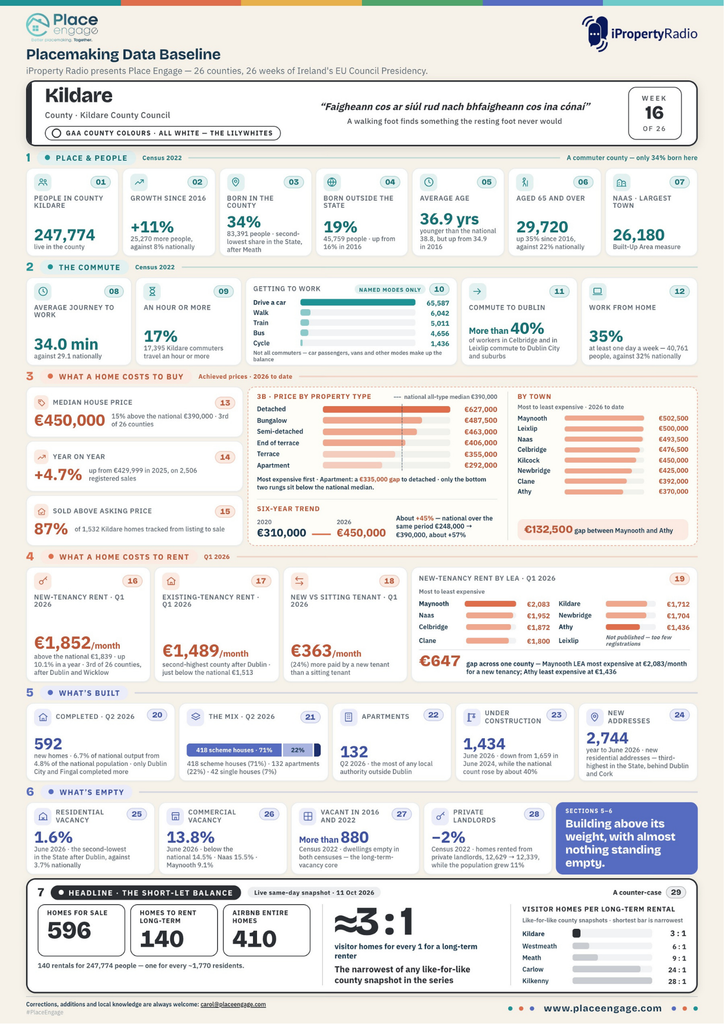
🇪🇺 Week 16 of 26: Place Engage arrives in County Kildare – a county of arrivals, organised around the commute, where only one resident in three was born locally. After Dublin and Wicklow, it is the most expensive county in the State to buy or take a new tenancy in, and almost nothing stands empty. This week I realised that County Kildare is where I personally know the highest number of children, young people and young adults so it was great to capture these voices and perspectives. [*Over the past 15 weeks of speaking with strangers on the streets, I only approached those clearly over 18 years of ages, and only chatted to children in the presence of such adults, which tended to be in primary school; the teen voices – though vital for inclusive placemaking – have been absent).
247,774 people, up 11% since 2016 · only 34% born in the county · 34-minute average commute, 17% travelling an hour or more · median house price €450,000 (15% above national) · new-tenancy rent €1,852 (above national) · 592 homes completed in Q2 2026, 132 of them apartments · residential vacancy 1.6% · 410 Airbnb entire homes against 140 to rent long-term.
Through iProperty Radio, Place Engage is undertaking a non-political placemaking series across 26 counties throughout the 26 weeks of Ireland’s EU Council Presidency. Each county week builds a Placemaking Data Baseline from primary sources before we arrive, and then our time on the ground is spent listening to people and exploring where the published record tracks lived experience, and where it diverges.
A personal note before the data
Kildare is a county I know well. I did not expect it to show me something new about this series, but it did.
Sixteen weeks in, Kildare is the county where I know the most young people – children of every age and young adults. That made me look back over the series with a question I had not asked before: whose voices have we actually heard?
As a rule, our conversations on the streets over the past 15/16 weeks have been with adults, or with young people in the company of adults. That is deliberate. Research best practice is not to approach under-18s directly, and this placemaking series has held to that. The consequence is that the teen voice has been largely absent from the record.
It matters for placemaking because teenagers use a place differently from anyone else. They depend on it more, with no car and little money, and in a few years they will decide whether to stay. Knowing so many families in Kildare gave us a way to hear them without approaching anyone on the street: through families I know, with parental consent. Their answers are set out further down, and they do not always match what the datasets would have led us to expect.
A county of arrivals, organised around the commute
Kildare’s population grew 11% between 2016 and 2022, to 247,774, against 8% nationally (CSO Census 2022 Summary Results, Kildare). Only 34% of residents were born in the county; 48% were born elsewhere in Ireland and 19% outside the State. The CSO names Kildare second-lowest in the State on this measure, after Meath. The county is young, with an average age of 36.9 against 38.8 nationally, but ageing fast: residents aged 65 and over rose 35% in six years, against 22% nationally.
Kildare is also a county of large towns. Seven have more than 10,000 people, led by Naas at 26,180, followed by Newbridge, Celbridge, Maynooth, Leixlip, Athy and Kildare Town.
The commute shapes everything. Kildare’s 100,856 commuters averaged 34 minutes to work in April 2022, against 29.1 nationally, and 17% travelled an hour or more; the CSO describes both as among the highest in the country. Some 65,587 drove to work, against 5,011 by train and 4,656 by bus. More than 40% of workers in both Celbridge and Leixlip commuted to Dublin City and suburbs. One school-travel figure stands out: in Kill, 82% of secondary students used public transport, the highest rate in the State among towns of 1,500 or more. Remote working is already part of the pattern, with 35% of the workforce working from home at least one day a week, against 32% nationally.
Expensive, and pulling apart
On the transaction record, the median achieved price in County Kildare was €450,000 in 2026 to date, up 4.7% on 2025 and 15% above the national €390,000 – third of 26 counties, behind Dublin and Wicklow (HousePrice.ie’s county page for Kildare, drawn from the PSRA Residential Property Price Register; data to 7 October 2026). These are achieved prices – what buyers actually paid – and are not the same as the asking prices (more below).
A detached house sold for a median of €627,000 and an apartment for €292,000, a gap of €335,000. Only apartments and terraces sold below the national median. Over six years the county median rose from €310,000 to €450,000, about 45%, while the national median rose about 57%. Kildare remains well above the national level, but in percentage terms it has risen more slowly.
The county figure averages two different markets. In the north-east, close to Dublin, Maynooth’s median is €502,500 and Leixlip’s €500,000. In the south, Athy’s is €370,000, €132,500 below Maynooth.
87% of Kildare homes sold for above their asking price.
Rents tell the same story. A new tenancy in Kildare averaged €1,852 a month in Q1 2026, up 10.1% in a year and above the national €1,839 (RTB/ESRI Rent Index Q1 2026). Kildare is one of only three counties above the national new-tenancy average, after Dublin and Wicklow. A sitting tenant pays €1,489, so moving costs €363 a month more. Within the county, the Maynooth electoral area is the most expensive at €2,083 for a new tenancy – more than several Dublin electoral areas – and Athy the least expensive at €1,436. Yet Athy is the only Kildare area where new-tenancy rents have grown faster than 7% a year in each of the last six quarters.
The less expensive end of the county is catching up.
Building above its weight, with almost nothing empty
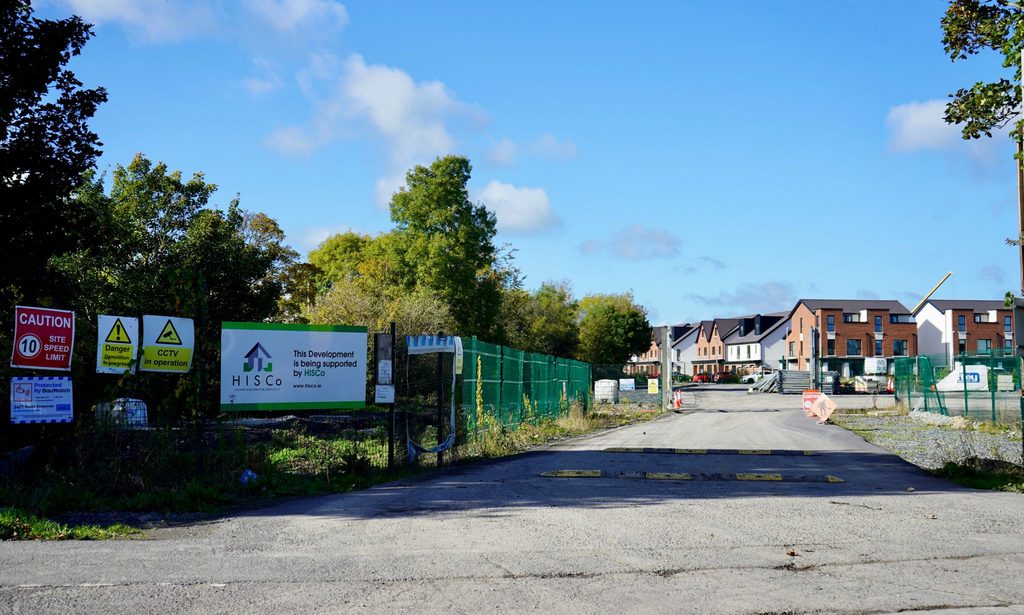
Kildare completed 592 new homes in Q2 2026, 6.7% of national output from 4.8% of the population. Only Dublin City and Fingal completed more of any local authority. Of those, 418 were scheme houses, 42 one-off houses and 132 apartments. That apartment figure is the most of any local authority outside Dublin, and unusual in this series, where county after county has built almost none.
The pipeline is less certain. GeoDirectory recorded 1,434 residential buildings under construction in Kildare in June 2026, down from 1,659 two years earlier, while the national count rose by about 40%. Residential vacancy was 1.6%, the second-lowest in the State after Dublin, against 3.7% nationally. Commercial vacancy was 13.8%, below the national 14.5%, ranging from 15.5% in Naas to 9.1% in Maynooth (Kildare Nationalist, reporting GeoDirectory).
The Census – while dated – adds the structural detail. Homes rented from private landlords fell 2% between 2016 and 2022, from 12,629 to 12,339, while the population grew 11% (CSO Census 2022 Profile 2, Kildare).
The short-let balance: a different kind of pressure
On a live capture on 11 October 2026 there were 596 homes advertised for sale and 140 to rent long-term across the county on Daft.ie, against 410 entire homes on Airbnb. That is about three visitor homes for every one offered to a long-term renter – the narrowest balance of any like-for-like county snapshot in the series, against six to one in Westmeath, 9 in Meath, 24 in Carlow and 28 in Kilkenny. Kildare also has the most rental listings per head of those counties, about one for every 1,770 residents.
These are live platform snapshots, not stock figures, and they move week to week. But they point to a different diagnosis from the counties where short-lets dominate. Kildare’s pressure is not homes diverted to visitors. It is a market where almost nothing stands idle, and where demand from Dublin, from the university and from new households absorbs whatever is built.
The view from the market: measured, informed and realistic
To test the baseline against someone close to the transactions, we spoke to IPAV agent Bryn Peters of Sherry FitzGerald Brady O’Flaherty in Maynooth. He describes a market that is strong but has changed pace. “The Kildare market is strong overall. However, it is a more measured market than we’ve seen over the last 12 or 18 months,” he says. The register agrees: the county median is up 4.7% this year, and Maynooth’s 3%.
- Supply is up, but not where it is wanted/needed: “Across Kildare, although we’ve seen a slight increase in supply in 2026, there is still a lack of supply in good quality homes,” he says. “Quality homes, three and four bedroom properties, particularly in the more established developments, are in real high demand at the moment.” Semi-detached houses are the most-traded type in Kildare this year, with 450 sales at a median of €463,000.
- Maynooth’s price point: In Maynooth, he sees three-bed semis achieving in the region of €450,000 to €480,000. In his account, that level is set by first-time buyers and, in many cases, downsizers. He does not need to sell the town at a Saturday viewing: “Go and take a walk along the main street and go and see for yourselves,” he tells buyers. “The town speaks for itself.”
- Buyers who check the comparables: “Buyers are still as motivated as ever, and they’re just as informed as ever,” he says. They check recent sales in the area and educate themselves “using Google, using AI”. In his account, they are “less willing to chase a property simply because there isn’t much else available”. He calls it a healthy marketplace, with buyers looking around before they make big decisions. That sits alongside the 87% of homes that still sold above asking. Informed buyers and above-asking outcomes are not in conflict if buyers are bidding hard for the right homes rather than for any home.
- First-time buyers and affordability: First-time buyers remain motivated, “but we are seeing affordability take real effect now,” he says, particularly across the commuter belt and in Maynooth. As prices rise, some look further afield, to Kilcock or even Enfield, “to get a little bit more for their money”. Kilcock’s median is €52,500 below Maynooth’s. Enfield is across the county line in Meath, so some of this north Kildare demand is leaving the county altogether.
- Investors, and the student-parent buyer: A lot of investors left the market in late 2025 and into 2026 with the new rental laws, he says, but there has been “a little bit of an uptick” in buy-to-let interest in Maynooth. The detail particular to Maynooth is a buyer no dataset will show. Parents from the Midlands and further west, unable to find rental or student accommodation for the academic year, sometimes buy a small two-bed apartment as a two- to four-year investment while their children attend the university, then sell it on. In his account, more than 17,000 students bring a vibrancy to the town that shows up in market interest.
This is a Maynooth version of something the series keeps finding: private capital doing the job the rental market cannot. In Carlow, it was a cash buyer converting a building into apartments to let. Here, it is a family housing its own student. It sits beside the highest new-tenancy rent of any Kildare electoral area, €2,083 a month in Maynooth.
Athy: the town that should be further ahead
Athy is a town I knew well growing up. It was where we went on Sunday afternoons, to the public swimming pool, and it had the only playground I knew as a child. I mention it because it shaped how I read the town now. For a child, a swimming pool and a playground are not amenities on a list; they are the reason a town matters. It is the same thing the young people of south Kildare told us this week, in their own words.
Athy is also a puzzle. It is 72 km from Dublin, on the main rail line to Heuston, linked to the M9, with a bypass opened in 2023 and housing well below the county’s prices. On paper, it should be one of the commuter belt’s most obvious places to live. Yet by most measures it sits well behind the towns to its north. The question this week was why, and whether that is changing.
What the data shows
Athy is Kildare’s sixth-largest town, with 11,035 people in 2022, up 12% since 2016 (Kildare County Council, Census 2022 profile). Its median achieved house price in 2026 to date is €370,000, 18% below the county median and 22nd of 24 Kildare towns (HousePrice.ie’s Athy page, drawn from the PSRA register; data to 15 October 2026). A new tenancy in the Athy electoral area costs €1,436 a month, the least expensive in the county (RTB/ESRI Rent Index, Q1 2026).
The social indicators explain part of the gap. Kildare is the fourth most affluent local authority in the State, but the Athy Municipal District is the only one in the county rated below average on the Pobal deprivation index. Nearly one in five of its residents live in areas classed as disadvantaged, and small areas in Athy West Urban are among the most disadvantaged in the country. In Athy, 31.3% of families with children under 15 are headed by a lone parent, double the county rate.
The rail line is not doing the work it could. In the area around Athy, only 5% of commuters went to work by public transport at the last census, half the national rate, and 85% drove. The direct journey to Heuston takes about 50 minutes, but the service is not hourly. In a reply to a parliamentary question, Irish Rail said an hourly service would require additional fleet and infrastructure capacity, and that extra services depend on demand and National Transport Authority approval (as published by Kildare South TD Mark Wall, June 2025).
A town centre that waited for its road
For years, through traffic ran straight through Athy’s medieval core. The Athy Distributor Road, a 3.4 km southern bypass funded under Project Ireland 2040, opened on 31 October 2023. Only then could the town centre be given back to people.
Emily Square shows how long that took. The council published its plans for the square in July 2018. Works began in September 2024, after the bypass opened, and the square reopened on 12 September 2025 with new paving, lighting and seating, reorganised traffic, a town tree, two murals and an illuminated line tracing the Barrow. It was funded with more than €2.7 million through Fáilte Ireland’s Regenerative Tourism and Placemaking Scheme, under the EU Just Transition Fund. Seven years from plan to opening is a long time in a child’s life – long enough for a teenager to leave school and leave town before the square is finished.
The square has been transformed, but the streets around it tell a different story. Athy has one of the highest concentrations of derelict sites in the county, with properties on the council’s register on Duke Street, Leinster Street, Stanhope Street and Woodstock Street. There are early signs of change: plans to replace a Leinster Street shop with a café and seven apartments, and permission for eleven homes on a derelict protected structure further along the same street. Whether they are built will say a lot about whether ‘living over the shop’ can work in a town like Athy.
The supermarket that took seven years
Locally, many people say Athy lost years because large retailers were kept out. The planning record documents one case in detail. A neighbourhood centre with an anchor supermarket, four shop units and 76 parking spaces was proposed on Geraldine Road, about 1 km from the town centre. Local residents objected in 2005 and a local supermarket in 2009, and the planning authority found in the objectors’ favour both times. In 2011, RGDATA, the body representing independent grocers, appealed on the grounds that the site would undermine the town centre. An Bord Pleanála granted permission in May 2012, with the backing of Athy Chamber of Commerce. Aldi opened in the town in March 2016.
Those objections were made on retail-policy grounds: protecting the town centre from edge-of-town shopping. That raises a question worth asking without assigning blame. If the aim was to protect Athy’s main streets, why do those streets now carry some of the highest dereliction in the county? The record shows a delay of at least seven years for one scheme. Whether the wider pattern amounts to “lost decades” is something I would like to hear from the people of Athy who lived through it.
Catching up, from a long way back
Something is now moving. Athy’s median price has risen from €150,000 in 2020 to €370,000 in 2026, and registered sales have doubled. Much of that rise reflects new estates selling at higher prices rather than existing homes doubling in value, but the building is real. Rents in the Athy area have grown faster than 7% a year in each of the last six quarters, the only part of Kildare to do so.
Are people choosing Athy, or affordability?
The census figures that describe the town’s disadvantage date from April 2022, before the bypass, the new square and the new estates. The next census will show whether Athy has finally started to become the town its location always suggested it should be. The test, for me, is simpler. Is there somewhere for a child to swim on a Sunday afternoon, a playground worth walking to, and a reason for a teenager to stay?
South Kildare: what villages and young people told us
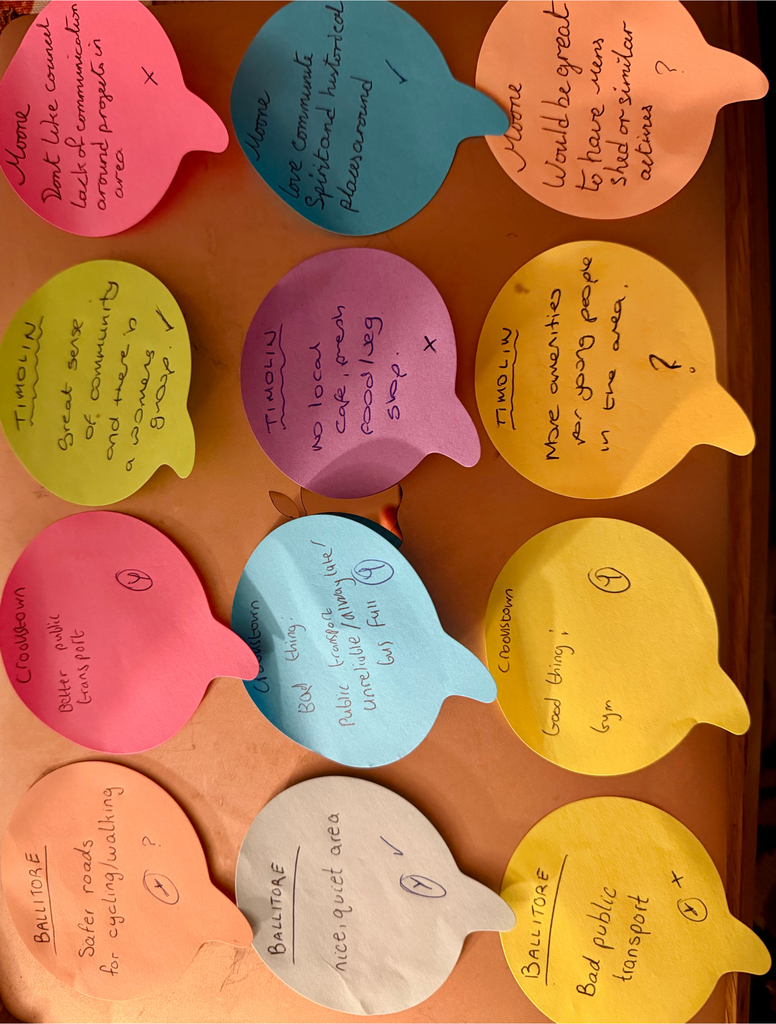
Far from the north-east towns, we asked people in four villages in the south of the county what they value about where they live, what frustrates them, and what they would add. In Moone and Timolin we heard from adults; in Crookstown and Ballitore, from young people.
The adults spoke first about community. In Moone, people value the community spirit and the historical places around them. In Timolin, they described a great sense of community, built in part around a women’s group. Their frustrations were about the everyday supports that hold a village together. Timolin has no local café and no shop for fresh food or vegetables. A Moone resident wanted to hear more from the council about projects planned for the area – a request to be kept informed, not a complaint about what is being built. And both villages asked for places to gather: a men’s shed or similar activities in Moone, and more amenities for young people in Timolin.
The young people answered the same three questions, and one theme ran through almost everything they said: getting around. In Crookstown, the bad thing was public transport that is unreliable, always late, and full when it does come; what they wanted was better public transport. The good thing was the gym. In Ballitore, they liked that it is a nice, quiet area, but named bad public transport as the problem and safer roads for cycling and walking as the change they would make.
That is the finding I keep returning to. The data on Kildare is dominated by one kind of journey: the adult commute to Dublin, by car, of 34 minutes or more. It is a real story, and the baseline is right to lead with it. But it is not the journey that shapes a teenager’s life in south Kildare. Their journey is to school, to a part-time job, to a friend’s house or to the gym – without a car, on a bus that may be full, or on a road they do not feel safe walking. The county records 82% of secondary students in Kill using public transport, the highest rate in the State. That figure says the demand is there where the service is. In Crookstown and Ballitore, young people are telling us what it is like where the service is not.
None of these young people mentioned house prices. But the adult figures will reach them soon enough. In a county where a new tenancy costs €1,852 a month and the median home €450,000, whether they can stay will depend on more than a bus timetable. Kildare is where this series finally asked them, and it should not be the last county where we do.
The takeaways for Kildare
- First, Kildare is a county of arrivals, organised around the commute. Two in three residents were born elsewhere, the over-65s grew 35% in six years, and one commuter in six travels an hour or more.
- Second, it is expensive, tight and still building. Kildare ranks third in the State on both achieved prices and new-tenancy rents, with 1.6% residential vacancy. It builds above its population share, including more apartments than any local authority outside Dublin. Its pressure is not empty homes or homes lost to visitors, but a market where almost nothing stands idle. And it is two markets: a north-east at or above €500,000, and a south where Athy is €132,500 below Maynooth but rents have risen fast for six quarters running.
- Third, Kildare gave the series its first sustained hearing from teenagers, and they changed the question. Where the data speaks of commuting to Dublin, young people in south Kildare spoke of getting to school, to work and to each other, by bus or on foot. Hearing them depended on families, consent and trust built up over years, which is not something a street engagement can replicate.
As ever, this is a starting point only. Kildare is a county I know well, which is exactly why I want what is set out here tested against what residents and practitioners see day to day – in Naas, Newbridge, Maynooth, Celbridge, Leixlip, Athy, Kildare Town and the villages of the south. Does the data match what you see?
Corrections and contributions are always welcome: carol@placeengage.com